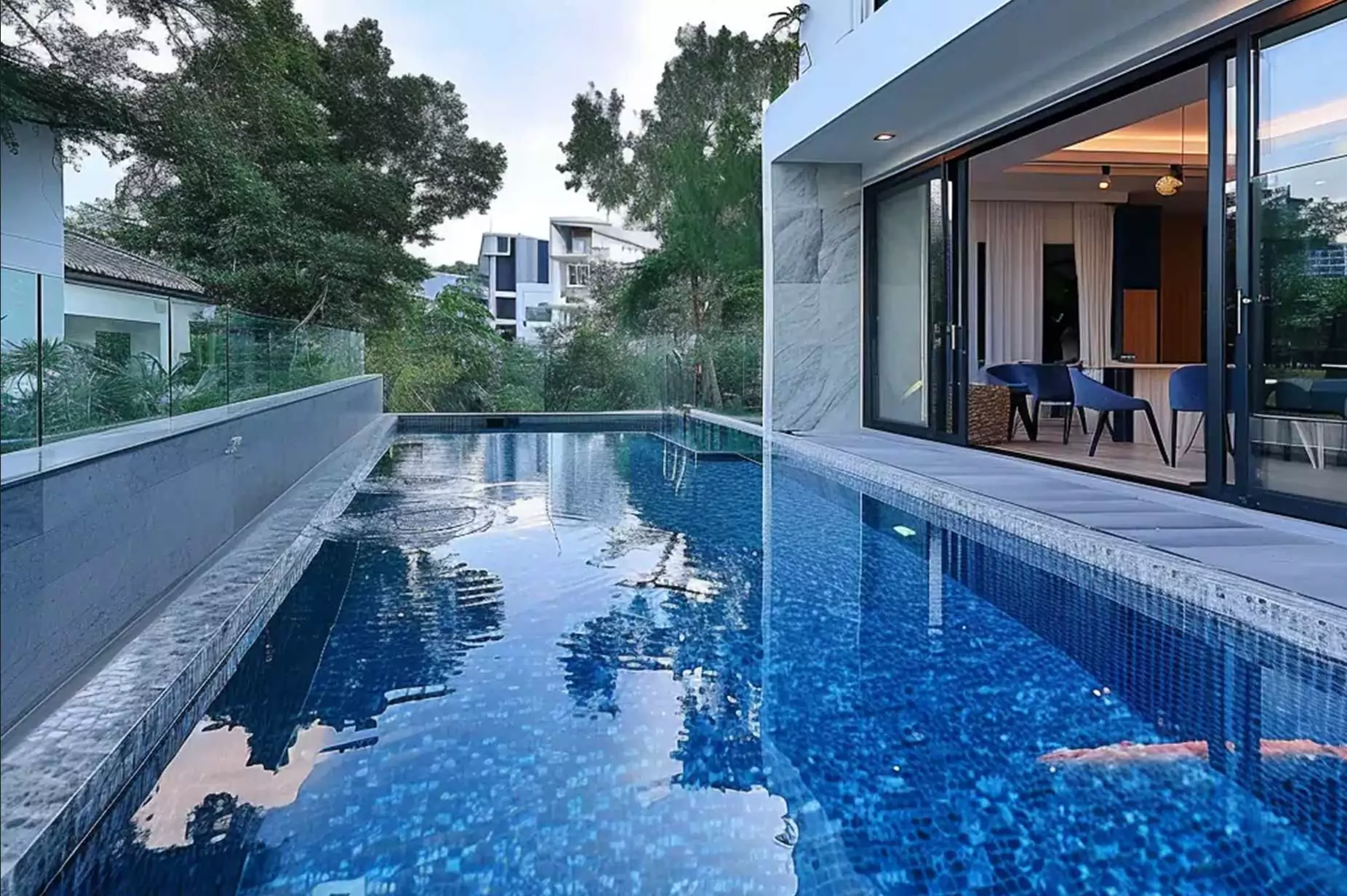
A swimming pool is one of the most popular wish-list items when homeowners plan a landed house rebuild. It can also be one of the trickiest parts to get right. Where the pool sits, whether it is sunken or raised, how the water drains and how you keep children safe all affect your approvals, your structure and your day-to-day life in the house.
Here is a plain-English guide to the official rules we could verify from URA, BCA, PUB and NEA, plus the practical points to plan for before you build.
Do You Need Approval to Build a Pool at a Landed House?
In most cases, yes. A pool is building work, and your Qualified Person (QP) will advise which clearances you need from each authority.
URA: Planning Rules for Pools
URA’s Landed Housing e-Advisor sets these rules for swimming pools at landed houses:
- Sunken pools may abut common boundaries.
- Raised pools must be set back 7.5m from the road reserve line and 2.0m from common boundaries (3.0m in Good Class Bungalow Areas).
- Appropriate measures must be taken to prevent water splashing into the neighbouring property.
The same rules appear in URA’s guidance for semi-detached houses. If you already have a pool, URA’s land-titled residential renovation guide says planning permission is not required to change the shape of a pool when it does not increase the size of the pool or reduce the existing setbacks.
Does a Pool Count as GFA?
URA’s GFA handbook states that a covered swimming pool is included as GFA. This matters if you are thinking of an indoor pool or a pool under a roof or trellis. For more on what counts, read our guide on GFA vs built-up area for landed houses.
BCA: Plans and Permits
BCA says a permit is required for all building works except those classed as insignificant building works in the First Schedule of the Building Control Regulations (BCA structural plan submission). Only a QP who is a registered Professional Engineer in the civil or structural discipline can apply for structural plan approval, and structural works can start only after a permit is issued. BCA also advises owners to engage a QP to check the clearances needed (building works not requiring approval). Your QP will confirm whether your pool design needs plan submission. This is especially important for raised or rooftop pools and pools near retaining walls.
PUB: Where Pool Water Must Go
The Sewerage and Drainage (Sanitary Works) Regulations state that all backwash water from a pool filter must be discharged into the sewerage system, and open shower points for pools must connect to storm water drains (Singapore Statutes Online). PUB’s Code of Practice on Sewerage and Sanitary Works adds that backwash water goes to the sewer via a floor trap, a pool balancing tank must not be connected to the sewer, and sanitary pipes must not run above pools or their balancing tanks. Your QP and licensed plumber will design this.
Choosing the Right Type of Pool
- Ground-level (sunken) pool: the most common choice. Under URA’s rules it can sit closer to boundaries than a raised pool.
- Raised pool: useful on sloping sites, but it must meet URA’s setbacks.
- Rooftop or upper-storey pool: saves garden space, but adds a heavy load to the structure. It must be designed from the start by your structural engineer.
- Lap pool: long and narrow, a good fit for the side of a terrace or semi-detached plot.
- Plunge pool: small and deep, for cooling off rather than swimming.
Practical Points to Plan For
Soil, Piling and Structure
Water is heavy. Your engineer will look at the soil investigation, the foundations and any nearby retaining walls or neighbours’ structures before fixing the pool’s position. A pool next to a boundary needs extra care so excavation does not affect the next-door house.
Waterproofing
Leaks are expensive to fix once tiles are down. Ask how the pool will be waterproofed and tested before finishing, and how any rooms below or beside it are protected.
Filtration and Plant Room
Pumps, filters and the balancing tank need space, access for servicing and a proper drainage connection. Plan this room early so it does not eat into your garden or car porch.
Trees on Site
If a tree stands where you want the pool, check the NParks rules first. See our guide to NParks tree removal rules.
Child Safety
BCA’s list of exemptions for landed houses notes that certain safety barrier requirements do not apply to landed houses built for the owner’s own use. That means safety is largely your choice, so plan it in. Consider a fence or gate around the pool, a safety cover, self-closing doors to the pool area and slip-resistant tiles on the deck.
Mosquitoes and Maintenance
NEA warns that mosquito breeding in your home can lead to a fine of up to S$5,000, jail of up to 3 months or both under the Control of Vectors and Pesticides Act (NEA dengue inspection). Keep the water circulating and treated, clear the deck drains and covers, and never leave the pool half-empty with stagnant water.
Add the Pool During a Rebuild or Later?
If you are planning a house reconstruction, it is usually far easier to include the pool from day one. The structure, piling, drainage and plant room can be designed together, and approvals are handled in one set of submissions. Adding a pool later can mean digging near finished foundations, rerouting pipes and new approvals. Also remember the pool must be complete before your final inspections; see our guide on TOP vs CSC.
Homeowner Checklist
- Decide on sunken, raised, rooftop, lap or plunge pool.
- Ask your QP to check URA setbacks and whether the pool affects GFA.
- Confirm BCA plan and permit needs with your structural engineer.
- Check soil, retaining walls and neighbours’ structures.
- Plan the plant room, balancing tank and backwash connection to the sewer.
- Agree on waterproofing and water testing before tiling.
- Plan child safety: fence, gate, cover and slip-resistant deck.
- Check for trees that may need NParks approval.
- Set a maintenance routine to keep water clean and mosquito-free.
Frequently Asked Questions
Can a swimming pool be built right next to my neighbour’s boundary?
URA allows sunken pools to abut common boundaries. Raised pools must be set back 2.0m from common boundaries (3.0m in Good Class Bungalow Areas) and 7.5m from the road reserve line.
Does a swimming pool count as GFA?
URA states that a covered swimming pool is included as GFA. Your QP will confirm how your design is treated.
Do I need BCA approval for a pool?
BCA requires a permit for all building works except insignificant building works listed in the Building Control Regulations. Your QP will confirm what your pool needs.
Where does pool backwash water go?
Singapore’s sanitary works regulations require pool filter backwash water to be discharged into the sewerage system. PUB’s code says this is done via a floor trap.
Is it better to add a pool during a rebuild?
Usually yes. Designing the pool with the house lets the structure, drainage and approvals be planned together.
Planning a Pool for Your Landed Home?
Three E Building Construction Pte Ltd (3E Build) can help you plan a pool that fits your plot, your approvals and your family. Email enquiry@3ebuild.com or call +65 8885 8815. Builder with Integrity.
Sources checked on 8 November 2026 (Singapore time). This is general guidance, not professional or legal advice. Requirements depend on your plot and design; your QP will confirm site-specific requirements.