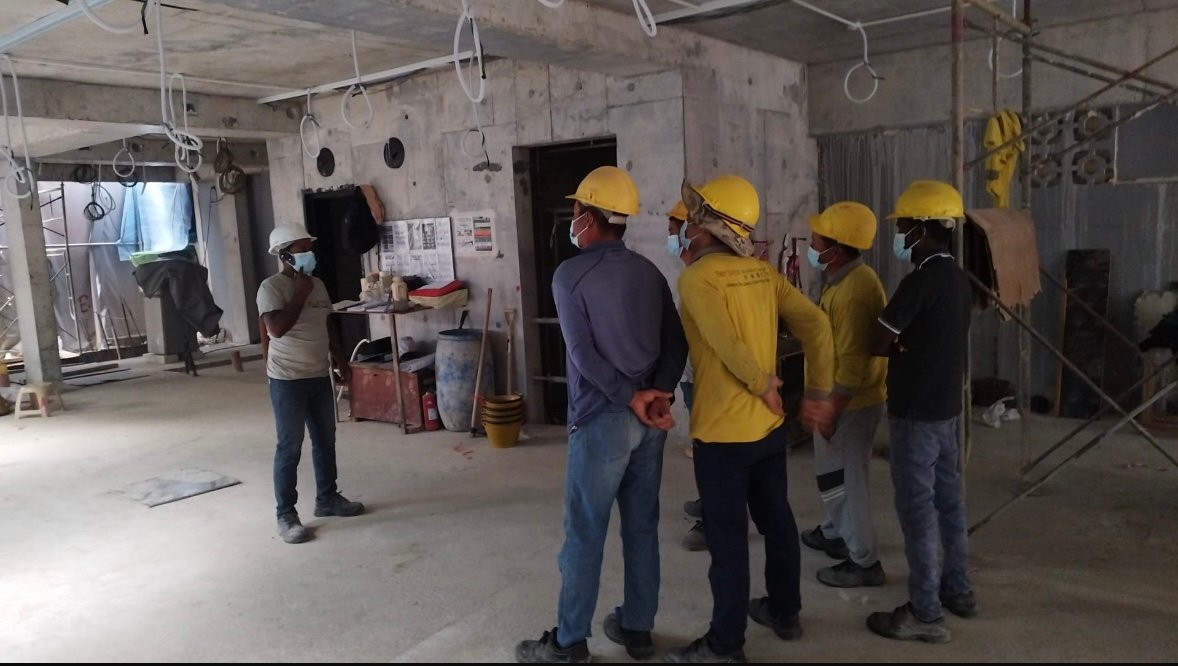
If you are planning a landed house rebuild or addition and alteration (A&A) works, the site still has to be safe. Construction site safety Singapore rules apply even when the job looks small. The Workplace Safety and Health Council’s 8 October 2026 Insights notice makes that plain. In 2025, small-scale construction works, including A&A and renovation, resulted in five fatalities and 90 major injuries. The Ministry of Manpower’s (MOM) Workplace Safety and Health (WSH) Report 2025 gives the sector share. Those works accounted for 64% of the construction sector’s fatal and major injuries that year.
MOM’s 1H 2026 WSH report, released on 8 September 2026, shows the same pattern continuing. Smaller-scale works, such as A&A and renovation, accounted for 70% of the sector’s fatal and major injuries in the first half of 2026. The WSH Council also says MOM will be conducting targeted inspections of small-scale construction works in the coming months. This article follows official MOM, WSH Council, Building and Construction Authority (BCA) and National Environment Agency (NEA) sources checked on 23 November 2026. It does not invent fines, contract-sum thresholds or typical durations. Where official pages do not publish a figure, that is stated plainly.
Who Is Responsible on a Landed Construction Site
The Workplace Safety and Health Act sets duties for several parties. The homeowner is not automatically the occupier of the worksite. The usual legal roles are different, and they matter for construction site safety Singapore.
The owner as principal
MOM says a principal is a person or organisation who engages another under a contract for service, to supply labour or perform work. When you appoint a builder, you are a principal. As a principal, you must ensure that the contractor you engage is able to perform the work. You must also ensure that the contractor has made sure any machinery, equipment, plant, article or process used at work is safe. However, if you instruct the contractor or the workers on how the work is done, you also take on an employer’s duties. Those employer duties include risk assessments, a safe work environment, emergency systems, and sufficient instruction, training and supervision.
The occupier is usually the main contractor
For workplaces that are not registered or notified as a factory, MOM defines the occupier by control, not by ownership. The occupier is the person who has control of the premises. Construction worksites are still “factories” under the WSH Act. They are premises where building operations or works of engineering construction are carried out. From 1 April 2019, however, construction worksites no longer need to be registered with MOM.
MOM’s 19 September 2019 circular answers the practical question. In general, there should only be a single occupier holding charge, management and control of a specific worksite. Unless there is a clear contractual demarcation, the main contractor appointed by the developer remains the occupier. Specialist contractors and sub-contractors must still coordinate with the main contractor so that their work does not compromise workers’ safety and health. Official sources do not say that a landed homeowner is, by default, the occupier. Ask your builder who is named as the occupier for your site.
As occupier, the contractor must take reasonably practicable measures to keep the workplace safe. That duty also covers the means of access and egress, and any machinery, equipment, plant, article or substance kept there. It applies to every person on the premises, whether or not that person is an employee.
Safety appointments and Design for Safety
The occupier of a worksite must appoint a workplace safety and health co-ordinator if the contract sum is less than $10 million. The co-ordinator must have completed the required training course. The occupier must also reasonably believe the person is competent and has at least two years’ relevant practical experience. Where the contract sum is $10 million or more, the occupier must appoint a workplace safety and health officer in writing. Official sources do not publish a typical contract sum for a landed rebuild, so your QP or builder should confirm which appointment applies.
All construction worksites must implement a safety and health management system (SHMS). If the contract sum is less than $30 million, an internal review of the SHMS is required every six months. If the contract sum is $30 million or more, an SAC-accredited WSH Auditing Organisation must audit the SHMS. That audit is required every six months, based on ConSASS.
From 1 June 2024, MOM also requires a video surveillance system at construction sites with a contract sum of $5 million and above. Ask your builder whether that threshold applies to your contract.
The Workplace Safety and Health (Design for Safety) Regulations 2015 apply only to a narrower set of projects. The project must be undertaken by a developer in the course of the developer’s business. It must also involve construction work of a contract sum of $10 million or more, and development under the Planning Act. The WSH Council’s Design for Safety guidelines give a direct example. A person building a good class bungalow with a contract sum of $12 million for their own occupation is not covered. Even so, the WSH Council encourages developers, designers and contractors to apply Design for Safety to all building projects.
bizSAFE is a WSH Council programme, supported by MOM. It is not itself a substitute for the law. The WSH (Risk Management) Regulations require risk assessments for work activities. Those assessments must be reviewed when the work changes, or at least every three years. bizSAFE Level 3 and above recognises that a company has systems to manage workplace risks and complies with those risk-management rules. You can ask whether your builder is bizSAFE-certified, but the legal duty is to carry out the risk assessments.
Common Hazards on a Landed Rebuild or A&A Site
The 8 October 2026 Insights notice lists the lapses commonly seen on small-scale sites. They include inadequate fall protection, unsafe work at height, improperly assembled formwork, electrical hazards, and unsafe access to and from work areas. The good practices below come from that notice and from the underlying regulations.
Falls and work at height
Work at height includes work at an elevated workplace, near an opening or edge, or on a surface. It covers situations where a person could fall from one level to another and be injured. Hazardous work at height is work from which a person could fall a distance of more than 3 metres. A construction worksite is a factory under the WSH Act. A permit-to-work system is therefore required for that hazardous work. The exception is where adequate and effective edge protection has already removed the risk of falling more than 3 metres. The occupier of any worksite where work at height is carried out must also establish and implement a documented, site-specific fall prevention plan. That plan must be available for inspection.
The WSH Council encourages companies to install proper guardrails or barricades at all open sides and floor openings. Floor openings should be covered and barricaded, and those edges should be marked with prominent safety signage. Only workers who have completed WSH training for work at height should be deployed for that work. One official example is the Workforce Skills Qualifications Perform Work at Height Course.
Scaffolds and formwork
All scaffolds at a workplace must be erected, altered, maintained or dismantled only by trained scaffold erectors. They must work under the immediate supervision of a trained scaffold supervisor. No scaffold, including a tower scaffold of any height, may be used until a scaffold supervisor has inspected it upon completion. Inspections must then be repeated at intervals of not more than 7 days, or earlier after weather likely to have affected it. The inspection results must be entered in a register before the scaffold is used. Tower scaffolds, including proprietary aluminium tower scaffolds, do not require an approved scaffold contractor to erect them, regardless of height. Other scaffolds may require an approved scaffold contractor. Ask your builder which type is being used, and to show you the inspection register.
Formwork must be properly erected, braced and supported in accordance with the approved formwork design. The WSH Council says companies should use only approved materials and components.
Excavation, basements and demolition
A basement, a sunken pool or another excavation brings extra duties. The WSH (Construction) Regulations set those duties for the occupier by depth. Where the depth exceeds 1.5 metres, or the banks are undercut, adequate shoring must be provided. The exception is where a professional engineer has examined the excavation and certified that it is safe without shoring. Where the depth exceeds 4 metres, the shoring must be designed by a professional engineer. No work other than excavation or shoring may take place inside until the required professional engineer’s certificate has been issued. Open sides of an excavation more than 2 metres deep must have adequate guard-rails. Notices must warn people about the excavation. The excavation and its vicinity must be inspected by a designated person after every rain storm or other hazard-increasing occurrence.
Demolition and foundation work also affect your neighbours. Before starting demolition, piling, foundation, tunnelling or site formation works, the builder must carry out a pre-construction survey of nearby buildings and structures. For landed property, the builder must also inform the neighbours, and obtain written consent for access where necessary. BCA’s Be Good Neighbours guide was amended in October 2025. It tells owners that the builder should take safety measures such as robust hoarding or netting along common boundary walls. If the house is older, an asbestos survey may also be required before demolition or renovation starts.
Lifting, electrical work and housekeeping
If a crane is used, the responsible person must establish and implement a lifting plan. A lifting supervisor must also be appointed before the operation starts. That supervisor must have completed an acceptable training course and have at least one year’s relevant lifting experience. The supervisor must coordinate the lift and supervise it in accordance with the lifting plan. For a mobile or tower crane lift, only registered crane operators, appointed riggers and appointed signalmen may take part.
The WSH Council also highlights electrical hazards and poor housekeeping on small sites. Electrical installations, equipment and extension cords should be properly maintained and protected from damage. Work areas should be kept clean, tidy and free of trip hazards, with materials stored neatly and walkways kept clear. Safe access to and from all work levels should be provided and maintained, for example with properly constructed staircases.
What Construction Site Safety Singapore Looks Like, and What to Ask
You do not need to run the site yourself. You should, however, be able to see basic construction site safety Singapore controls and get clear answers from your builder. Before work starts, and again when you visit, ask:
- Who is the occupier of the worksite, and who is the appointed WSH co-ordinator or WSH officer?
- May I see the risk assessments for the work now under way, and when were they last reviewed?
- Is there a fall prevention plan, and is a permit-to-work in place for hazardous work at height?
- Who erected the scaffold, when was it last inspected, and can I see the inspection register?
- If there is excavation deeper than 1.5 metres or 4 metres, has the required shoring or professional engineer’s certificate been provided?
- If a crane will be used, who is the lifting supervisor, and is there a lifting plan?
- Has the pre-construction survey been done, and have the neighbours been notified?
- Have early checks such as the sewerage and drainage interpretation plans and, where required, the asbestos survey been programmed before demolition?
- Does the contract sum meet MOM’s $5 million video surveillance threshold, or the $10 million Design for Safety or WSH officer thresholds?
On a walk-around, look for hoarding or netting at the boundary, and guardrails or covers at openings. Also look for clear access routes, tidy storage and protected electrical cables. Those are practical signs of construction site safety Singapore done properly. If you see an unsafe act or condition, MOM says you should report it.
Accidents, Stop-Work Orders and the Programme
If a worker is injured, the employer must submit an incident report to MOM. For a fatal accident, the employer must notify the Commissioner and submit the report within 10 days of the accident. For a non-fatal accident, the report is due within 10 days of the employer’s first notice of the accident. A member of the public or a self-employed person may be injured as a result of the works and sent to hospital. If that happens, the occupier must notify the Commissioner. That notice must be given as soon as reasonably practicable. Dangerous occurrences, such as a mobile crane toppling, must also be reported by the occupier, whether or not anyone is injured. Failure by an employer to report an accident can attract a fine of up to $10,000 for a first offence. For a subsequent offence, the maximum is a $20,000 fine, jail of up to 6 months, or both.
MOM’s Commissioner may also issue a remedial order or a stop-work order. A stop-work order directs the person served to immediately cease the work or process. The stoppage may be indefinite, or it may last until the measures required by the Commissioner have been taken to the Commissioner’s satisfaction. Official pages checked on 23 November 2026 do not publish a typical number of days for a stop-work order to be lifted. Until it is lifted, that work cannot resume. The rebuild or A&A programme is therefore delayed for as long as the order remains in force. Failing to comply with a stop-work order can attract a maximum fine of $500,000, imprisonment of up to 12 months, or both. There is also a further fine of up to $20,000 for each day the offence continues after conviction. A remedial order carries a maximum fine of $50,000, imprisonment of up to 12 months, or both. There is also a further $5,000 a day after conviction.
For other WSH Act offences with no specific penalty, MOM states the general maximums as follows. An individual faces up to $200,000 or 2 years’ imprisonment, or both, on a first conviction. A corporate body faces up to $500,000 on a first conviction. Those maxima rise to $400,000 and $1 million respectively for a repeat offender. From 1 June 2024, MOM also increased the maximum fines under subsidiary legislation from $20,000 to $50,000. That increase applies to breaches that could result in death, serious bodily injury or a dangerous occurrence.
The programme can also be affected by NEA’s construction noise rules, even when there is no accident. Construction sites located within 150 metres of residential buildings or other noise-sensitive premises face a no-work rule. Work is not allowed from 10.00 pm on Saturday until 7.00 am on the following Monday, unless NEA has issued a permit. The same rule runs from 10.00 pm on the eve of a public holiday until 7.00 am on the day following the public holiday. Permitted quieter work, where granted, is subject to conditions. Official examples include restricted hours from 10 am to 5 pm, and no use of heavy machinery or noisy powered tools. On other days, sites near residential buildings must also keep within NEA’s published noise limits, which become tighter after 7 pm and 10 pm.
Frequently Asked Questions
Is construction site safety Singapore law applicable to a small landed A&A, or only to large sites?
It applies. The WSH Act applies to workplaces, and a construction worksite is a workplace where building operations are carried out. Official figures show the same pattern on small sites. Those A&A and renovation works accounted for 64% of the construction sector’s fatal and major injuries in 2025. They accounted for 70% in the first half of 2026. MOM has said it will conduct targeted inspections of small-scale construction works.
Am I, as the homeowner, the occupier of the worksite?
Not automatically. MOM says that, in general, the main contractor appointed by the developer remains the occupier, unless there is a clear contractual demarcation. You are a principal when you engage the builder. If you instruct the contractor or the workers on how the work is to be carried out, you also take on the duties of an employer. Ask your builder who is named as the occupier.
Does Design for Safety apply to a landed house I am rebuilding for my own use?
Usually not, on the official test. The Design for Safety Regulations apply only where three tests are met. The project must be undertaken by a developer in the course of the developer’s business. It must also have a contract sum of $10 million or more, and involve development under the Planning Act. The WSH Council’s guidelines give a direct example. A good class bungalow with a $12 million contract for the owner’s own occupation is not covered. The Council still encourages Design for Safety on all building projects. Confirm the position with your QP if the project is commercial, or if an existing Design for Safety register already applies to the building.
What should I expect to see on a safe landed site?
Official good practices include guardrails or covers at openings, and safe access to every work level. You should also see inspected scaffolds, properly braced formwork, protected electrical cables and tidy walkways. For deeper excavations, you should also expect shoring or a professional engineer’s certificate, guard-rails where the depth exceeds 2 metres, and warning notices. Ask to see the risk assessments, the fall prevention plan, and the scaffold inspection register.
What happens if MOM issues a stop-work order?
The person served must immediately cease the work or process. The stoppage may be indefinite, or it may last until the measures required by the Commissioner have been taken to the Commissioner’s satisfaction. Official pages do not publish a typical duration for lifting an order. The programme is therefore delayed for as long as the order remains in force. Failing to comply can attract a maximum fine of $500,000, imprisonment of up to 12 months, or both. A further daily fine can also apply after conviction.
Can my builder work on Sundays or public holidays?
Not as a default, if the site is within 150 metres of residential buildings or other noise-sensitive premises. NEA’s no-work rule runs from 10.00 pm on Saturday to 7.00 am on the following Monday, unless a permit is issued. The same rule runs from 10.00 pm on the eve of a public holiday to 7.00 am on the day after the holiday. Ask your builder whether a permit has been granted, and what conditions apply.
How much do stoppages or safety appointments cost, and how long do they add to a landed rebuild?
Official MOM, WSH Council, BCA and NEA pages checked on 23 November 2026 do not publish those figures. There is no standard cost for a WSH co-ordinator, a scaffold, a stop-work delay or a typical safety-related extension of a landed-house programme. The only official time marks in this article are the appointment and inspection intervals, and the incident-reporting deadlines. They also include the six-monthly SHMS review or audit, the three-year risk-assessment review, and NEA’s no-work hours. Ask your builder for a written programme that includes those statutory holds.
Build Safety Into the Programme From the Start
At Three E Building Construction, we build landed home rebuilds, extensions and A&A works. We work with your architect and engineers so site safety, neighbour protection and the construction programme sit in the right order. If you are planning a landed house, talk to 3E Build. Builder with Integrity.